
RSI Europe skipped the crowded drone race — and it paid off
In modern warfare, speed is becoming the defining advantage. Systems that once took years to design and deploy are now expected to reach the battlefield in months — or risk becoming irrelevant before they are ever used.
RSI Europe is a Lithuania-based defence tech company building remote-controlled explosive systems and drone technologies designed for rapid deployment in active conflict environments.
I spoke with CEO Tomas Milašauskas on a visit to Vilnius to learn how the company achieved rapid time-to-market and profitability from year one.
From energy regulation to defence tech
Tomas Milašauskas started his career as a public servant in energy regulation, setting electricity prices in Lithuania and working on European-level infrastructure projects, including interconnectors with neighbouring countries.
After that, he moved into consulting, and then became a fund manager in renewable energy — investing across Eastern Europe in solar, wind, energy storage, and other EU-aligned projects.

Culture as a competitive edge in a company born out of urgency
“In Lithuania, defence isn’t just about the army — it’s a whole-of-society effort,” says Milašauskas.
“It includes the military, volunteer organisations, and industry.”
That ethos is reflected internally at RSI Europe.
“A large part of our team has direct links to defence — former or current military personnel, volunteers, or people like myself involved in organisations such as the Riflemen’s Union,” he explains, referring to the civilian force of around 17,000–18,000 members trained to support national defence. This shared context shapes how the company operates.
“There’s a clear understanding of the threat, and a very clear goal,” Milašauskas says.
“When you’re building these systems, you know they could ultimately protect your own country, your family, your loved ones. That responsibility gives the work real meaning — and it’s what keeps us pushing forward.”
That context became reality overnight. Russia’s full-scale invasion of Ukraine changed everything. When everything escalated, the company’s owners had a moment of: “What do we do now?”
“It reached a point where it felt like a direct threat to Europe,” he explained.
“That’s when my brother and I decided to launch a company focused on defence technology — specifically to help Ukraine.”
Neither of them came from the armed forces, so they relied on what they did have — their finances and technical thinking. They started with remote initiation systems — RISE-1 systems — something they understood better because of their background in technical communications.
Speed: from concept to deployable product
Within a few months, as a team of just three people, they had already developed rough 3D-printed prototypes being tested by the Lithuanian Armed Forces.
After the first round of feedback, the second iteration was already deployed in Ukraine.
Initially, the team approached the military with ideas around smart, remotely controlled munitions — essentially IoT-enabled systems.
“They told us: that sounds great, but your time to market will be at least five years,” recalled Milašauskas.
If the goal was to help Ukraine win, they needed something deployable within 3 to 5 months.
So RSI Europe pivoted to remote initiation systems — focusing on the “smart” part without the munition itself. That allowed it to get into the field quickly.
RSI Europe stands out for its speed from idea to time-to-market. Milašauskas contends that if your development cycle is two or three years, your only option is to sell to NATO.
“If you want to sell to Ukraine, it has to be two to three months — maximum. The battlefield evolves constantly, so you have to react quickly.”
This is also about a shift in mindset:
”It’s not about having a perfect, polished system. It’s about whether it works. For example, a drone costing around €1,000 can destroy a tank worth several million. So the question becomes: do you want a perfect product, or an effective one?”
Starting with a niche product
According to Milašauskas, RSI Europe saw two paths — drones and remote initiation systems.
“We chose the smaller, less competitive product. In 2022, there was no defence funding available. Competing in drones would have been unrealistic for a small team with no capital.
So we focused on a system that had no real competitors. We started in Explosive Ordinance Disposal and expanded into broader military use — including special operations and intelligence units.”
Today, those systems are widely used for unexploded ordnance (UXO) clearance — especially in heavily mined areas following Ukrainian counteroffensives — allowing operators to initiate explosives remotely while staying at a safe distance, sometimes up to 25 kilometres away.
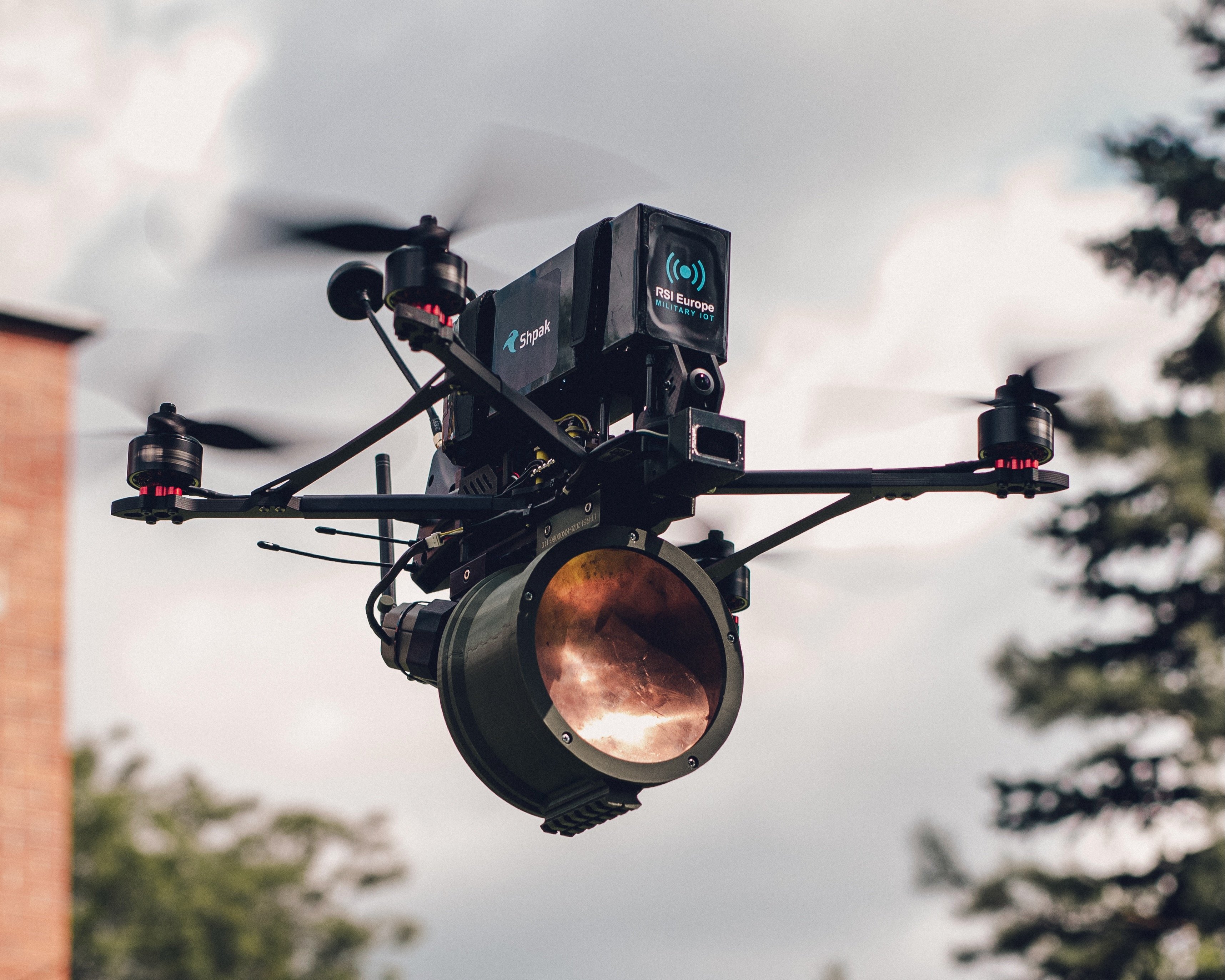
Its technology stack extends to LoRa-based radio communications, autonomous and semi-autonomous drone capabilities, and FPV drones optimised for precision strike operations in high-electronic-warfare conditions.
How RSI Europe’s technology works
Technically, the system architecture is relatively simple. At its core, it’s an IoT device. There is some edge processing — for example, drones receive simple commands and translate them into real-time control across multiple axes.
But the compute itself is relatively low. What really differentiates military systems is the networking layer: radio links must be highly resilient and capable of withstanding jamming and interference, using techniques such as advanced modulation and limited autonomy when signal conditions degrade. In addition, these systems operate at significantly higher power levels than consumer devices, ensuring more reliable connectivity in contested environments.
“As we move towards more autonomous systems, compute requirements increase — but for now, many systems remain relatively simple,” explained Milašauskas.
Profitable from year one
The company was initially bootstrapped with a personal loan of around €40,000 — a modest starting point by startup standards, particularly in a market where early-stage companies often raise significant capital before generating meaningful revenue. Yet within its first year of operation, the business generated approximately €170,000 in revenue, establishing a strong commercial foundation from the outset.
“We’ve been profitable since year one,” shared Milašauskas.
The funds provided the flexibility to focus on the product and the end user, rather than investor pressure.
Scaling challenges: logistics and deployment
A key challenge for the company going forward is logistics. Milašauskas explained that Ukrainian companies can deliver within 1 to 2 weeks.
“For us, exporting adds another two to three weeks. We also don’t always know where the product will end up — there’s often a gap between delivery and deployment.
That’s why we maintain local teams in Ukraine to support users and gather feedback.”
From hardware to doctrine
Beyond logistics, the challenge shifts from technology to application. Where do drones sit within the military structure — infantry, engineering, artillery?
To address this, the company has worked closely with the Lithuanian Armed Forces to develop a playbook for integrating these systems into real operations. As a result, its offering now goes beyond hardware and software to include practical operational know-how.
Autonomy and real-world limits
Tomas Milašauskas notes that some level of autonomy is already in use, including features such as terminal guidance, position hold, return-to-home without GPS, and early forms of swarm coordination. However, development remains cautious.
“In a chaotic environment, control is critical. If you lose control, you risk unintended consequences,” he says.
He adds that much of what is shown publicly does not reflect operational reality.
“Many public demonstrations take place in controlled environments — they’re not representative of real battlefield conditions.”
Looking ahead, Tomas Milašauskas points to two priority areas: building explosives capabilities — where he sees a clear gap in Europe — and advancing autonomy in drone systems.
Fragmentation, variety, and consolidation
Drones are fundamentally reshaping defence procurement, shifting it away from standardised, single-platform systems toward a model where diversity of capabilities — not uniformity — defines operational strength.
Tomas Milašauskas argues that, unlike traditional defence systems, drones require diversity rather than standardisation.
“With something like a fighter jet, you invest in one platform — it’s extremely expensive to maintain, requires specialised technicians, and takes years to deploy,” he says.
With drones, variety is the capability itself. Different systems perform differently depending on the environment. A drone that works in one part of the battlefield may be completely ineffective in another.
This shift is likely to reshape procurement models.
“Users will increasingly adopt a mix of capabilities rather than relying on a single system. That could mean multiple suppliers — or one supplier offering a range of specialised drones for different use cases.”
At the same time, the market is evolving rapidly. “It’s a massive space, with many players and a lot of capital coming in,” Milašauskas adds.
“Some are consolidating by acquiring smaller companies, others are building full ecosystems and trying to become the next primes. And many will simply disappear.
In the first year, five companies were supplying the Lithuanian military. Now it’s down to one or two — and new players continue to emerge.”
Startups should focus on specialisation
Tomas Milašauskas advises founders to focus on specialisation rather than building yet another drone.
“There are already many large players, and even more coming out of Ukraine at scale, so competing head-on with a new drone platform is very difficult,” he says.
Instead, he points to opportunities in the gaps around the ecosystem.
“There’s strong demand for specialised components, particularly as non-Chinese supply chains are still being built — and not yet fully there. Even basic elements, like magnets, often still come from China.”
He adds that innovation can go far beyond the drone itself.
“There’s a lot to be done with modular electronics, new components, and edge AI. It’s a strong market, but you need to be focused. Identify what’s already crowded, find the niche that isn’t, and build there.”
Powered by WPeMatico
 https://tech.eu/2026/05/06/rsi-europe-skipped-the-crowded-drone-race-and-it-paid-off/